
Tropical Outdoor Lighting Ideas for the Pacific Northwest: Warm, Lush, and Winter-Resilient
Create a warm tropical atmosphere in the Pacific Northwest with layered outdoor lighting. Learn placement rules, fixture types, budget tiers, and winter-proof strategies for palms and lush landscapes.
2/26/20262 min read
Most tropical landscapes in the Pacific Northwest disappear at night.
You’ve invested in windmill palms, bananas, lush foliage, and layered planting — but once the sun sets, everything flattens into darkness.
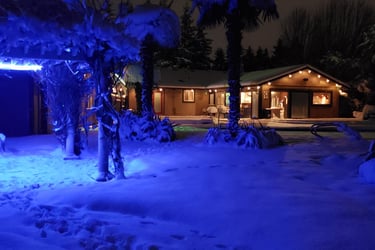
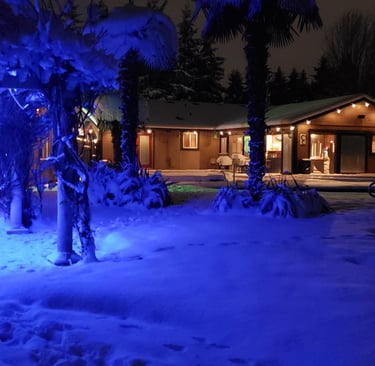
Strategic lighting transforms a yard from “plants in soil” to resort-level tropical living — even in February.
This guide breaks down how to design warm, layered, moisture-resistant outdoor lighting that works in our climate.
Quick Plan Box
Goal: Warm, layered tropical ambiance
Light Temperature: 2700K–3000K only
Primary Techniques: Uplighting + Path Glow + Accent Wash
Avoid: Blue-white LEDs, exposed wiring, over-lighting
Winter Focus: Moisture resistance + sealed connections
PNW Tropical Lighting Design Rules
1. Warm Light Only
Cool white kills tropical mood.
Stay between 2700K–3000K.
2. Hide the Source
You should see glow — not the fixture.
3. Light Texture, Not Just Height
Palms look best when fronds catch side-lighting, not just trunk beams.
4. Layer in Threes
Uplight feature plant
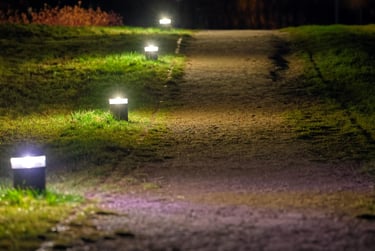
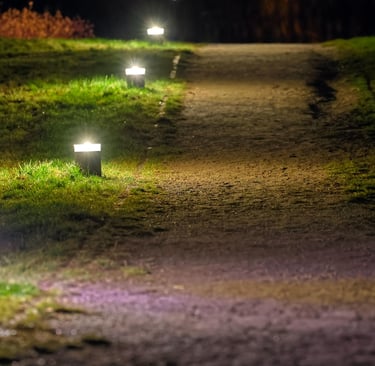
Soft path lighting
Low ambient wash near seating
Step-by-Step Tropical Lighting Layout
Step 1 – Uplight Your Anchor Palm
Place a low-voltage spotlight 12–18 inches from the trunk.
Angle upward to:
Highlight trunk fiber texture
Catch underside of fronds
Create shadow movement in breeze
We’ve had good results with 2700K low-voltage spotlights like the LEONLITE 12W LED Landscape Spotlight for trunk and frond uplighting.
(Field Note: In our damp winter soil, bury connections in gravel, not direct clay. Drainage prevents corrosion. Use waterproof wire connectors)
Step 2 – Add Soft Path Lighting
Install path lights staggered, not symmetrical.
Spacing:
4–6 feet apart for soft glow.
Goal:
Illuminate walking path without spotlighting the ground.
Avoid:
High-output fixtures — subtle is better.
For soft walkway glow, we prefer warm aluminum path lights like the SUNVIE 3W 2700K set — subtle enough to maintain ambiance without spotlighting the ground.
Step 3 – Accent Banana or Foliage Beds
Banana leaves look dramatic when backlit.
Use:
Wide-angle flood (not narrow beam).
Position:
Slightly off-center to create leaf silhouette.
Budget / Mid / Premium Setup
Budget Tier ($150–$300)
4 warm LED spotlights
6 path lights
Basic transformer
Good for:
Small yard, 1 focal palm
Mid Tier ($400–$800)
Brass or aluminum fixtures
Higher lumen output
Dusk-to-dawn timer
Sealed waterproof connectors
Best balance of durability + aesthetics
A 300W transformer like the DEWENWILS Low Voltage Landscape Transformer allows room for expansion as your tropical landscape grows.
Premium Tier ($1,000+)
Zoned lighting
Smart app control
Dimmable transformers
Integrated seating glow
Creates true resort effect.
Common Lighting Mistakes in the PNW
Using 5000K “security” lights
Overlighting (kills mood)
Ignoring moisture protection
Lighting only from ground level
Not testing at night before burying wires
Gather more Tropical Design ideas at Tropical Living & Design
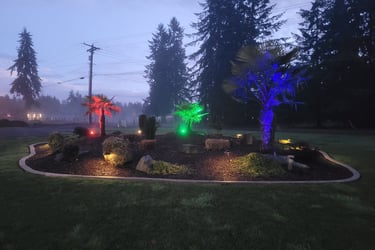
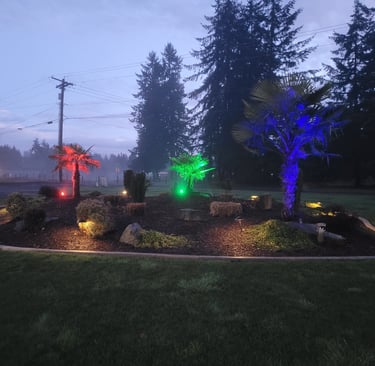
In our own yard, we found that lighting fronds from two angles created far more depth than a single spotlight. Also, fixtures rated for marine environments last significantly longer in saturated winter soils. We have found inexpensive solar lights work for about a year before experiencing issues.
Closing
Lighting is not an accessory — it is structural design.
Done correctly, your Pacific Northwest yard can feel like Maui at 8PM in February.
Contact Us
© 2025. All rights reserved.
Terms and Conditions
Affiliate Disclosure
Some links on this site may be affiliate links. As an Amazon Associate I earn from qualifying purchases.