
Adam’s Needle Yucca vs. New Zealand Flax: Which Is Better for a PNW Garden?
Compare Adam’s Needle Yucca and New Zealand Flax for Pacific Northwest gardens, including cold hardiness, winter moisture, size, maintenance, color, and tropical landscape use.
8/21/20266 min read
Adam’s Needle Yucca and New Zealand Flax can look surprisingly similar from a distance.
Both form dramatic clumps of long, sword-shaped leaves. Both stay evergreen in mild conditions. Both work exceptionally well as architectural accents in tropical-style Pacific Northwest gardens.
But they are not interchangeable.
Adam’s Needle Yucca (Yucca filamentosa) is considerably more tolerant of winter cold and dry conditions, while New Zealand Flax (Phormium) offers a broader range of foliage colors and a softer, more flowing appearance.
For Pacific Northwest gardeners, choosing between them usually comes down to cold tolerance, winter drainage, available space, and the look you want to create.
Quick Answer
If maximum cold hardiness and low maintenance are the priorities, Adam’s Needle Yucca is the safer choice.
If foliage color, size options, and a softer tropical appearance matter more—and you have a reasonably protected location—New Zealand Flax may be the better landscape plant.
In many tropical-style gardens, however, the best answer is not choosing one or the other.
It is using both.
Adam’s Needle Yucca at a Glance
Adam’s Needle (Yucca filamentosa) is a clump-forming evergreen perennial with stiff, pointed leaves radiating outward from central rosettes.
Depending on the variety, foliage may be solid green or variegated.
Mature plants produce tall flower stalks carrying clusters of creamy-white, bell-shaped flowers.
Its biggest advantages for Pacific Northwest gardeners are:
Excellent cold tolerance
Evergreen structure
Low water needs after establishment
Good drought tolerance
Impressive summer flowers
Relatively low maintenance
Its most important requirement is good drainage.
[INTERNAL LINK — Suggested anchor text: how to grow Adam’s Needle Yucca in the Pacific Northwest]
New Zealand Flax at a Glance
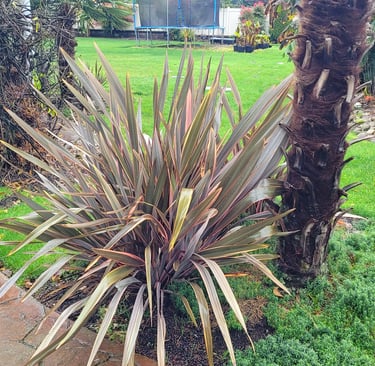
New Zealand Flax includes Phormium tenax, Phormium cookianum, and numerous cultivars and hybrids selected primarily for their foliage.
Unlike yucca’s rigid leaves, Phormium foliage generally has more flexibility and movement.
Depending on the cultivar, the leaves may be:
Green
Bronze
Burgundy
Red
Pink
Yellow
Cream
Variegated combinations of several colors
That range is one of Phormium’s biggest advantages in landscape design.
Different cultivars also vary greatly in mature size. Compact forms can work in containers and smaller beds, while large forms can develop into substantial specimen plants.
[INTERNAL LINK — Suggested anchor text: growing New Zealand Flax in a Pacific Northwest garden]
Cold Hardiness: Yucca Wins
This is the biggest difference between the two plants.
Adam’s Needle Yucca is extremely cold hardy for a plant with such a tropical or desert-like appearance.
Once established, winter temperatures typical of much of the lowland Pacific Northwest are usually well within its tolerance.
Phormium is less straightforward.
Cold tolerance varies considerably between species and cultivars. Some established plants can tolerate significant frost, while more tender cultivars may suffer leaf damage or even severe crown damage during a hard freeze.
That makes Phormium much more dependent on cultivar selection and planting location.
Cold-hardiness winner: Adam’s Needle Yucca
Pacific Northwest Winter Moisture
This comparison gets more interesting when rainfall enters the equation.
Yucca handles drought extremely well but dislikes prolonged waterlogged conditions.
In our climate, the biggest concern is often not whether a yucca can survive the temperature. It is whether its root system remains too wet through winter.
A sunny slope, raised planting area, gravelly bed, or naturally free-draining location is ideal.
Phormium generally tolerates more soil moisture than yucca, but it still performs best in soil that drains properly.
The difference is important:
Yucca prefers the drier end of the spectrum.
Phormium is more comfortable with consistent moisture as long as the soil isn't waterlogged.
If you have a naturally dry, sunny section of the landscape, yucca has the advantage.
In a typical garden bed with good drainage and regular summer irrigation, Phormium can be easier to integrate with surrounding plants.
Foliage: Completely Different Personalities
Although both plants have sword-shaped leaves, their landscape effect is different.
Adam’s Needle Yucca has relatively rigid foliage.
The leaves project outward from the rosette and create very strong geometric lines.
The effect is bold, sharp, and architectural.
Phormium leaves tend to be longer and more flexible. They arch and move more in the wind.
The effect is softer and often more tropical.
Think of it this way:
Yucca = structure
Phormium = movement
Neither is inherently better. They simply perform different visual jobs.
Foliage Color: Phormium Wins
This is one category where New Zealand Flax is difficult to beat.
The range of available foliage colors is enormous.
Dark burgundy Phormium can provide contrast against bright green palms and bananas.
Yellow or cream-variegated cultivars can brighten dark planting beds.
Pink and bronze selections can introduce colors rarely found in other evergreen architectural plants.
Yucca also has attractive variegated cultivars, including plants with yellow and cream coloration, but the overall color palette is much narrower.
Foliage-color winner: New Zealand Flax
Flowers: Yucca Wins for Display
Mature Adam’s Needle Yucca can produce spectacular flowering stalks.
These stalks rise well above the foliage and carry large numbers of creamy-white, bell-shaped flowers.
For several weeks, a flowering yucca can become one of the most noticeable plants in the garden.
Phormium can also flower.
Mature plants may produce tall stalks bearing tubular flowers, commonly in reddish tones. These flowers are interesting and can attract attention, but Phormium is generally planted for its foliage rather than for a predictable flower display.
Flower-display winner: Adam’s Needle Yucca
Which Plant Is Easier to Maintain?
Both can be relatively low-maintenance when planted correctly.
Adam’s Needle maintenance generally consists of:
Removing spent flower stalks
Removing dead or damaged leaves
Controlling offsets if the clump gets too large
Keeping the crown from becoming buried in wet debris
New Zealand Flax generally requires:
Removing old or damaged leaves
Cleaning damaged foliage after winter
Dividing oversized clumps when necessary
Removing old flower stalks when flowering occurs
One important difference becomes obvious after a severe winter.
Yucca will often come through cold weather with relatively little damage.
Phormium may require considerably more cleanup after an unusually hard freeze.
Overall maintenance winner: Adam’s Needle Yucca
Which Is Better for Containers?
For containers, I would usually give the advantage to New Zealand Flax.
There are many compact cultivars with attractive foliage specifically suited to pots and smaller spaces.
Phormium also combines particularly well with trailing plants and seasonal annuals.
A large container can use Phormium as the central architectural element—the “thriller”—with softer plants surrounding it.
Yucca can certainly be grown in containers, but its rigid, pointed foliage and spreading rosettes can become awkward in frequently used patio spaces.
Container winner: New Zealand Flax
Which Is Better Near Walkways?
This one deserves consideration before planting.
Adam’s Needle leaves terminate in pointed tips.
Planting one immediately beside a narrow walkway can result in people repeatedly brushing against stiff foliage.
Give yucca room.
Phormium foliage is generally more flexible, making it easier to use near patios and wider walkways.
That does not mean Phormium should be allowed to overwhelm a path, but it is usually the more forgiving plant where people regularly pass.
Walkway winner: New Zealand Flax
Which Is Better for a Dry Garden?
Yucca.
Once established, Adam’s Needle is extremely well suited to areas receiving relatively little supplemental summer irrigation.
That makes it particularly useful with:
Gravel gardens
Rock gardens
Sunny slopes
Dry borders
Mediterranean-style plantings
Water-conscious landscapes
New Zealand Flax can become drought tolerant after establishment, but most forms generally appreciate more consistent moisture than yucca.
Dry-garden winner: Adam’s Needle Yucca
Which Looks More Tropical?
This one is subjective.
Yucca produces a bold architectural look that can resemble agaves and other warm-climate plants.
Phormium tends to create a softer tropical effect because of its long, arching foliage.
If the goal is a lush tropical garden, I would lean toward Phormium.
If the goal is a bold tropical, Mediterranean, or exotic architectural garden, yucca may be stronger.
And when the two are combined, the contrast can be excellent.
Using Yucca and Phormium Together
You do not necessarily have to choose.
Both plants can work in the same landscape if their individual growing conditions are respected.
For example, place a yucca slightly higher in a sunny, fast-draining section of a bed.
Place Phormium nearby where the soil retains somewhat more summer moisture.
Then use broad-leaved plants behind or around them.
Possible combinations include:
Cannas
Hostas in adjacent shade
Carex
Ornamental grasses
The contrast between broad foliage and sword-shaped leaves is one of the easiest ways to make a tropical-style planting look intentional rather than crowded.
Side-by-Side Comparison
Choose Adam’s Needle Yucca if you want:
Maximum cold tolerance
Very low summer water requirements
Strong architectural foliage
Large white summer flowers
Minimal winter cleanup
A plant for sunny, dry conditions
Choose New Zealand Flax if you want:
More foliage-color choices
Softer, flowing foliage
Better container options
More choices in mature size
A lush tropical appearance
A plant that integrates easily with regularly irrigated beds
What About Variegated Yucca vs. Variegated Phormium?
This is an especially good comparison because both can provide bright yellow or cream-colored foliage.
A variegated Adam’s Needle has a much stiffer form.
Its leaves create a dense, almost starburst-like shape.
Variegated Phormium tends to be taller and more flowing.
For a strong focal point in a dry, sunny planting, I would choose the yucca.
For adding vertical color among palms, bananas, and other foliage plants, I would choose the Phormium.
Field Notes From Our Pacific Northwest Garden
We have both Yucca and Flax in our landscape. I have little experience with Yucca as I have not done much but cut the dead stalks before winter. Dividing them is in my future. New Zaland Red Flax is very dominate in our yard, occupying many beds both front and back. We did have a few damaged plants a few years back during a heavy snow, thought I lost them. Took a few years and they came back to full strength. I propagate the larger clumps every two years or so, they get to about six feet tall and almost that big in diameter. I will be posting propagation pictures later this year and be selling them in our Plants for Sale section, summer 2027.
Final Verdict
There is no universal winner because these plants solve different landscape problems.
For durability, cold hardiness, drought tolerance, and low maintenance, Adam’s Needle Yucca is the stronger choice.
For foliage color, movement, container use, and a lush tropical appearance, New Zealand Flax has the advantage.
If I were creating a Pacific Northwest tropical garden from scratch, however, I would not necessarily choose between them.
I would use the yucca where I need a tough evergreen anchor and use Phormium where I want color and movement.
That combination creates something more interesting than either plant can produce alone.




Contact Us
© 2025. All rights reserved.
Terms and Conditions
Affiliate Disclosure
Some links on this site may be affiliate links. As an Amazon Associate I earn from qualifying purchases.