
Japanese Forest Grass: A Soft, Flowing Shade Plant for Pacific Northwest Tropical Gardens
Learn how to grow Japanese forest grass in the Pacific Northwest and use its soft, cascading foliage to create a lush tropical shade-garden look.
5/20/20267 min read
When people picture a tropical-looking garden, they often think first of bold leaves: palms, bananas, Fatsia, Tetrapanax, or hostas. But some of the most convincing tropical effects come from movement and texture, not just leaf size.
That is where Japanese forest grass shines.
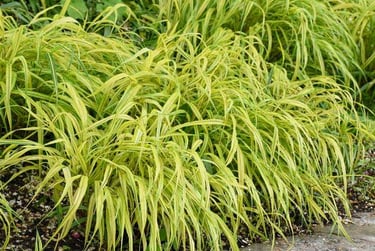
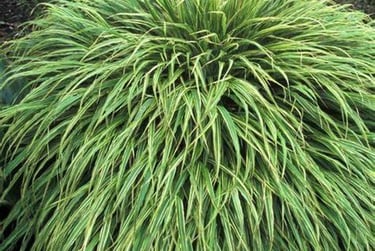
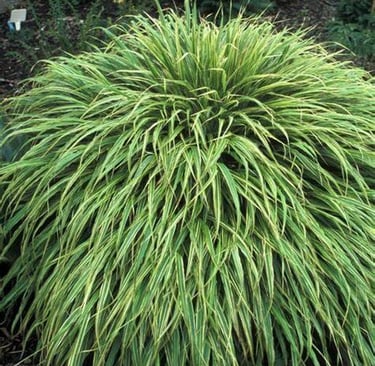
Japanese forest grass, also called Hakone grass or Hakonechloa macra, is a low, arching ornamental grass that forms soft, cascading mounds of foliage. In the Pacific Northwest, it can bring a graceful, almost waterfall-like effect to shady beds, woodland edges, garden paths, and layered tropical-style plantings. It is especially useful where you want a planting to feel lush and relaxed without using another large-leaf focal plant.
Quick Answer: Why Japanese Forest Grass Works So Well in PNW Tropical Gardens
Japanese forest grass is a strong choice for Pacific Northwest gardeners because it offers:
Soft, flowing foliage that moves naturally in the breeze
Excellent shade performance, unlike many ornamental grasses
A compact, mounding habit that fits paths, borders, and underplantings
Golden, green, or variegated foliage options depending on the cultivar
A tropical-looking texture that pairs well with palms, hostas, Fatsia, bamboo, and ferns
It is not a bold architectural plant. Instead, it is a texture plant — one that makes surrounding tropical foliage look even better.
Plant Profile: Japanese Forest Grass
Botanical name: Hakonechloa macra
Common names: Japanese forest grass, Hakone grass
Plant type: Deciduous perennial ornamental grass
Hardiness: Species hardy to about Zone 4; many ornamental cultivars are commonly listed around Zone 5 and warmer
Height: Usually about 12–20 inches tall, often wider than tall
Light: Part shade to shade; some sun tolerance depending on moisture and cultivar
Soil: Rich, evenly moist, well-drained soil
Growth habit: Slow-spreading, arching clumps; not considered invasive
Seasonal interest: Spring through fall foliage; dies back in winter and regrows in spring
What Makes Japanese Forest Grass Look Tropical?
Japanese forest grass does not resemble a palm or banana plant, but it contributes to a tropical design in a different way.
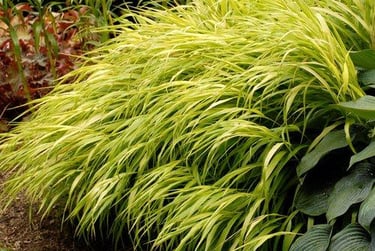
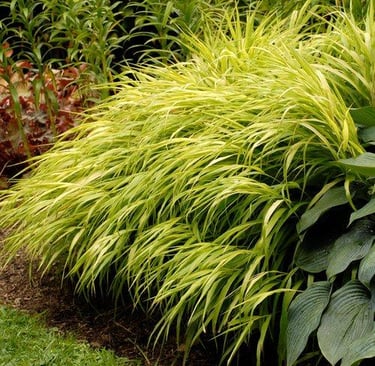
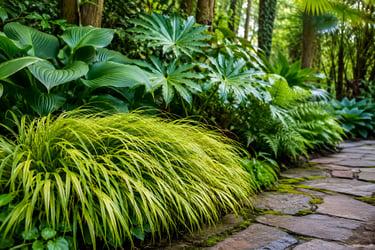
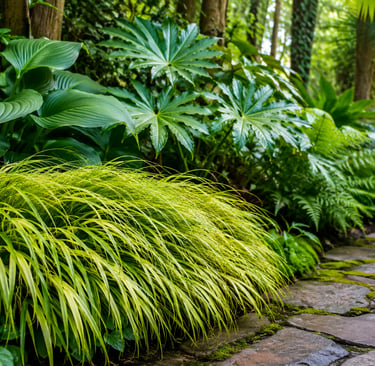
Its long, narrow leaves arch outward in soft layers, creating a lush, flowing ground-level texture. The plant often looks like a small fountain of foliage spilling over the edge of a bed, path, wall, or container. That movement breaks up stiff planting lines and helps a garden feel more natural and immersive. Wisconsin Extension even describes the effect as reminiscent of a cascading waterfall, while RHS notes that the arching, ribbon-like leaves create “green rivers” that move in the breeze.
In a Pacific Northwest tropical garden, this makes Japanese forest grass especially useful for:
Softening the base of palms or large foliage plants
Filling the foreground beneath hostas, Fatsia, and ferns
Brightening shaded planting pockets
Creating a calm, layered edge along paths and patios
Adding movement without introducing a tall or aggressive grass
Best Planting Locations in the Pacific Northwest
Japanese forest grass performs best where it gets light shade, dappled shade, or protection from hot afternoon sun, especially for golden and variegated cultivars. It prefers soil that stays consistently moist but not waterlogged, with good organic matter and drainage.
Good locations include:
Along the edge of a shaded garden path
Under or near larger shrubs and small trees
At the front of a woodland-style planting bed
In a moist, partly shaded courtyard or entry garden
On a slight slope or raised edge where the foliage can spill outward
Near boulders, water features, or stonework
Avoid planting it in:
Hot, dry, reflected-heat areas
Dense, poorly drained clay without improvement
Very dry soil under thirsty trees
Full sun locations where summer moisture is inconsistent
Leaf scorch can occur when the plant is exposed to too much heat or insufficient moisture.
Best Japanese Forest Grass Varieties to Consider
Several cultivars are especially useful in Pacific Northwest gardens. The right choice depends on whether you want brighter color, stronger variegation, or a more natural green effect.
‘Aureola’
One of the best-known forms, with gold and green striped foliage that brightens shady beds. It creates a luminous effect near dark foliage plants.
‘All Gold’
A more solid golden form that can stand out strongly in part shade. It is often a little brighter and more upright in appearance than some striped forms.
‘Albostriata’
A green-and-cream striped cultivar that tends to have a softer, more blended look and can work well where you want texture without an overly bright gold accent.
Straight species — Hakonechloa macra
The green form can be an excellent option when you want the flowing shape of the plant without turning it into a focal color accent. It may also appear a little more natural in woodland-style plantings.
How to Use Japanese Forest Grass in a Tropical-Looking Garden
Japanese forest grass is most effective when it is used intentionally as a layering plant.
1. Use it beneath bold foliage
The soft texture of the grass balances out large tropical-style leaves.
If you want a strong broad-leaf contrast, pair Japanese forest grass with hostas, which add bold shape and structure in Pacific Northwest shade gardens.
Good companions include:
Ferns
Astilbe
Brunnera
Hellebores
Wisconsin Extension specifically notes Japanese forest grass pairs well with hostas, ferns, Heuchera, Pulmonaria, Brunnera, and Astilbe in shaded gardens.
Check out our Database for more facts on these plants.
2. Let it spill over path edges
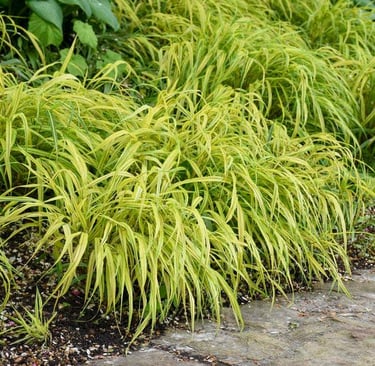
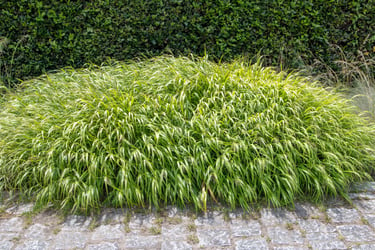
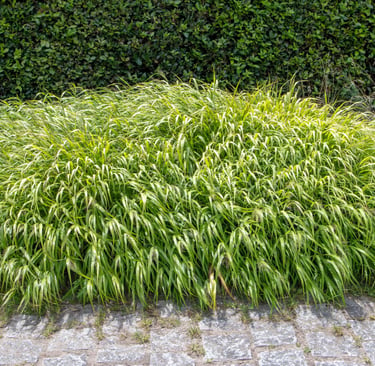
Japanese forest grass looks especially natural where its foliage can arch slightly into a walkway or drape over a stone border.
Japanese forest grass is especially effective along curved garden paths, where its arching foliage softens the edges and makes the planting feel more natural.
This is one of the best ways to use it in a tropical-style garden: not as a centerpiece, but as a plant that makes the entire composition feel fuller and more mature.
3. Use it to brighten shade
Golden and variegated forms can act like a soft light source in darker corners of the garden. Rather than relying on flowers, you get a long season of foliage contrast.
This can be especially valuable in Pacific Northwest gardens where many lush tropical-looking beds are built in partial shade or woodland conditions.
4. Pair it with larger structural plants
Japanese forest grass can help transition from large-scale plants to the ground plane.
If you want the planting to feel even more tropical, use Japanese forest grass near larger foliage plants like Fatsia japonica.
It also works nicely near bamboo-inspired planting schemes.
Its fine texture also pairs beautifully with bamboo-inspired plantings, especially where you want a calmer, layered understory.
Soil and Watering Tips
Japanese forest grass prefers rich, organic, evenly moist soil. It does not want constantly soggy conditions, but it also does not perform its best in dry, depleted ground. In the Pacific Northwest, this matters most from late spring through summer when rainfall drops and shady beds can become drier than expected.
A practical planting approach:
Loosen the planting area well
Mix in compost or organic matter if the soil is lean or compacted
Plant at the same depth as the nursery pot
Water deeply after planting
Add a light mulch layer to reduce moisture swings
If your planting area is dry or low in organic matter, mixing in a quality compost or soil conditioner before planting can help create the richer, moisture-retentive soil Japanese forest grass prefers.
A light layer of natural mulch around the plant helps keep the root zone more evenly moist through summer dry spells.
Does Japanese Forest Grass Spread?
Yes, but slowly.
Japanese forest grass expands gradually through underground rhizomes and spreading clumps, but it is not considered invasive. It may take time to establish and develop into a fuller mound. That slower pace is actually a benefit in refined garden beds, where you want a plant to fill space without aggressively overtaking its neighbors.
Seasonal Care
Japanese forest grass is fairly low maintenance once it is established.
Spring
Fresh growth emerges in spring, sometimes later than expected. Be patient before assuming the plant did not return. Wisconsin Extension notes that, like other warm-season grasses, Hakone grass can be relatively slow to reappear in spring.
Summer
Water during prolonged dry periods, especially for newer plantings and for plants receiving brighter light.
Fall
Many forms take on warm orange, bronze, or reddish tones before collapsing for winter.
Late Winter or Early Spring
Cut the old foliage back before new growth emerges.
In late winter or very early spring, the old foliage can be clipped back cleanly with a simple pair of garden pruners before fresh growth begins.
Common Mistakes to Avoid
1. Planting it in dry shade without improving the soil
Shade does not always mean moist soil. Under trees or near dense roots, the ground can be surprisingly dry.
2. Using it where a bold focal plant is needed
Japanese forest grass is a texture and transition plant. It is beautiful, but it usually works best supporting larger foliage rather than serving as the main statement.
3. Expecting fast coverage
This is not a rapid-spreading filler. It develops slowly and looks better over time.
4. Giving golden cultivars too much hot sun
Some light helps color, but too much sun combined with inconsistent moisture can lead to bleaching or scorch.
Field Notes From a Pacific Northwest Garden
In our own Pacific Northwest garden, Japanese forest grass works best where it can soften the edge of a shady bed rather than being buried behind taller plants. It earns its spot through movement: on breezy days, the foliage shifts just enough to make the planting feel alive. It is especially useful near bold-leaf plants because it keeps the area from feeling visually heavy.
Final Thoughts
Japanese forest grass is one of the most useful plants for creating a lush, layered, tropical-looking shade garden in the Pacific Northwest. It does not compete with palms, hostas, Fatsia, or bamboo-inspired plantings — it makes them look better.
Use it where you want softness. Use it where you want movement. Use it where a shaded planting bed needs a lower, flowing layer to feel complete.
For gardeners building a Pacific Northwest tropical style, Japanese forest grass is not just a filler plant. It is one of the best ways to make the whole design feel more polished and intentional.
For additional design ideas see our Tropical Living & Design section.
Contact Us
© 2025. All rights reserved.
Terms and Conditions
Affiliate Disclosure
Some links on this site may be affiliate links. As an Amazon Associate I earn from qualifying purchases.